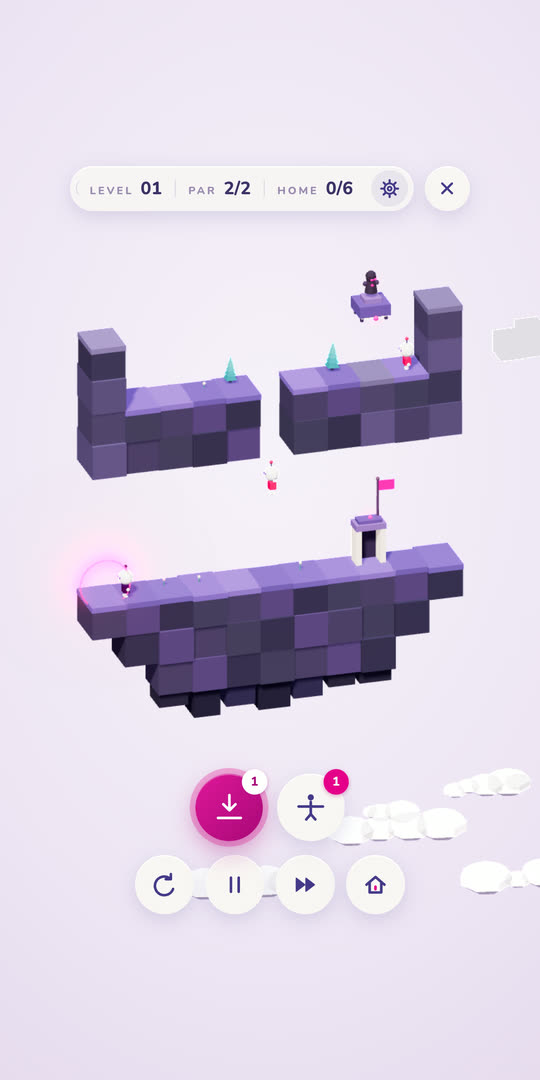
They drop and walk
A hatch opens and they come out one at a time, straight ahead, turning at walls and walking off edges without looking.


A calm puzzle about a stream of little robots that keep walking until you step in. They drop, they march, they turn at walls and they fall off edges.

You never touch a robot directly. You hand one of them a skill, and the whole line behind it follows the path that skill just made — a dug shaft, a built staircase, a body standing in the way.
Bring enough of them home and the next level opens. Bring all of them home, inside par, and the card gives you three flags. Nothing is timed, so the pressure is entirely a number you decided to care about.
Free permanently, like everything else here — no advertising, no in-app purchases, no subscription.
The reel
One recorded session, the first worlds, no cuts.
How it plays
Three things happen in every level, and the middle one is the whole game.
A hatch opens and they come out one at a time, straight ahead, turning at walls and walking off edges without looking.
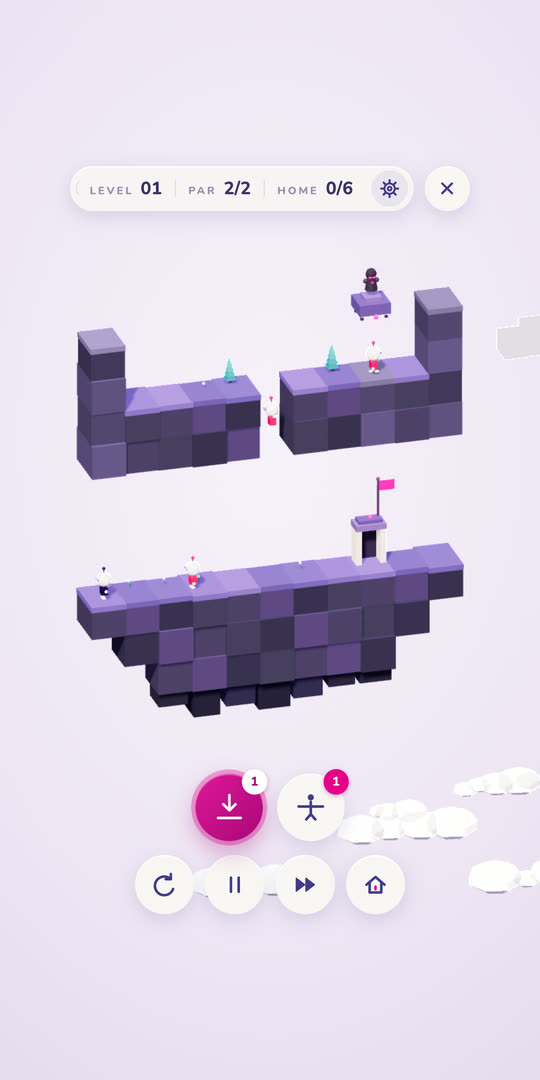
Tap a skill, tap a robot. Whatever it does to the level stays there, and every robot behind it follows the new route.
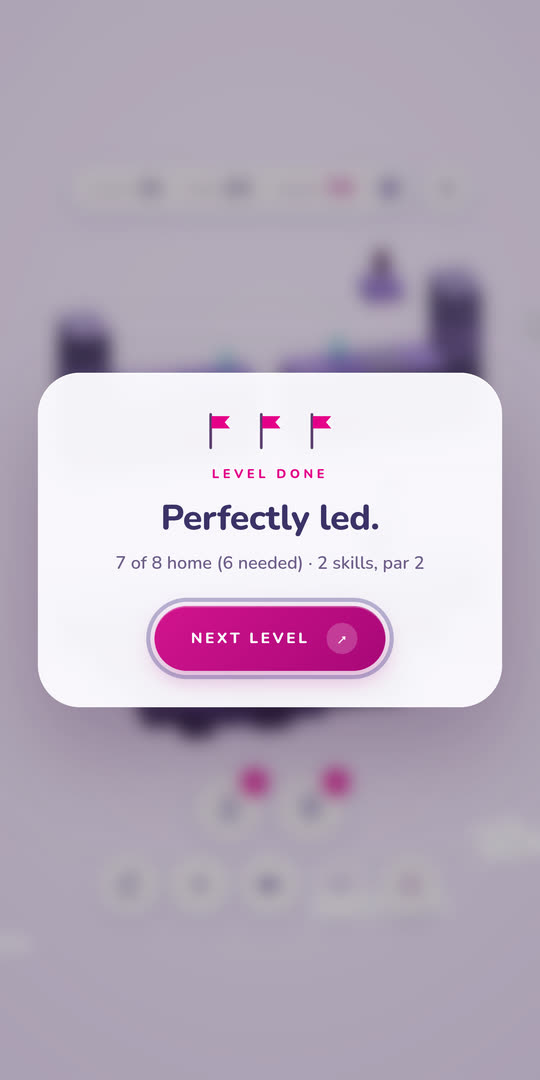
Enough of them through the door opens the next level. All of them, inside par, is three flags — and you can play it again for a better one.
Four worlds
Each world looks like itself and brings one new thing with it — something in the ground, in the air or in the way out.
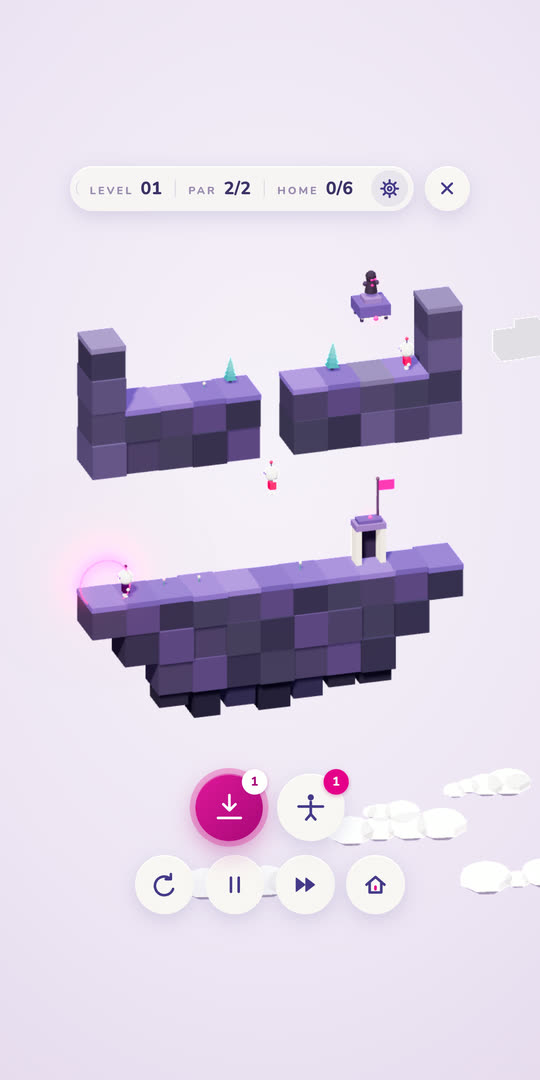
Violet blocks, small trees and open sky. Where you learn what a robot does when nobody stops it.
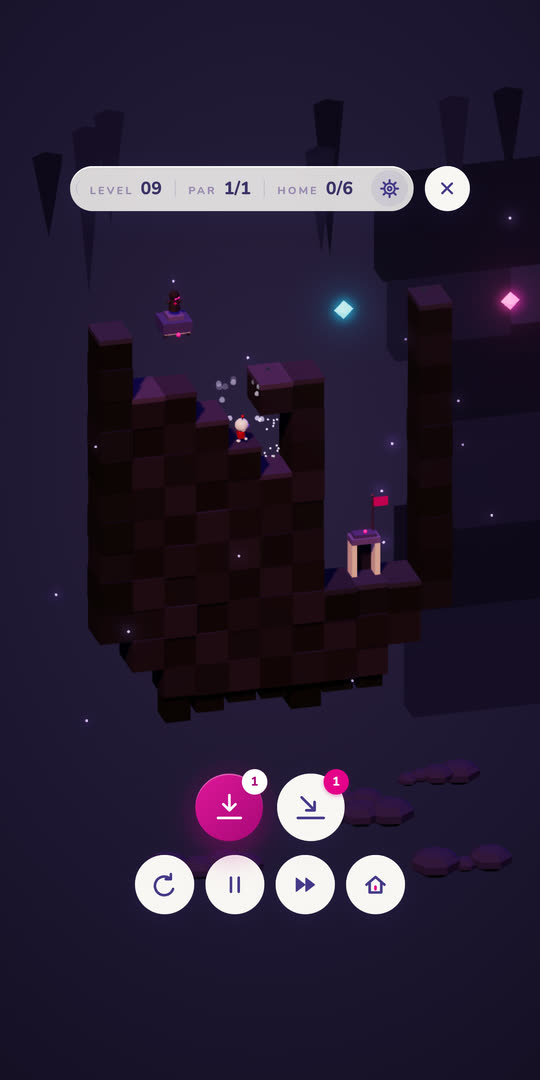
Underground and dark, lit by crystals. The ground is no longer something you can trust to stay there.
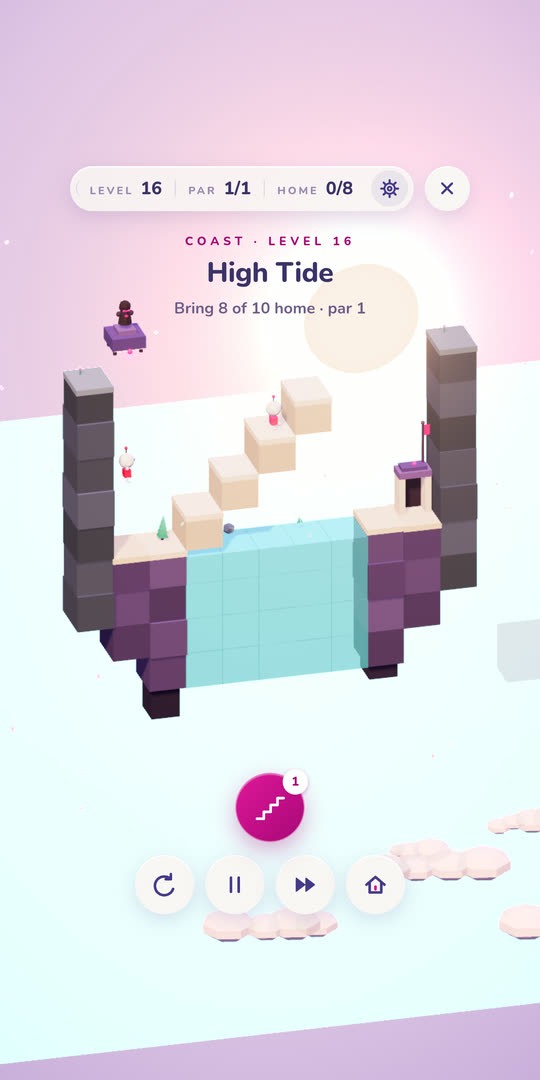
Pale sand under a low sun, with water you cannot walk across. Build over it or go around it.
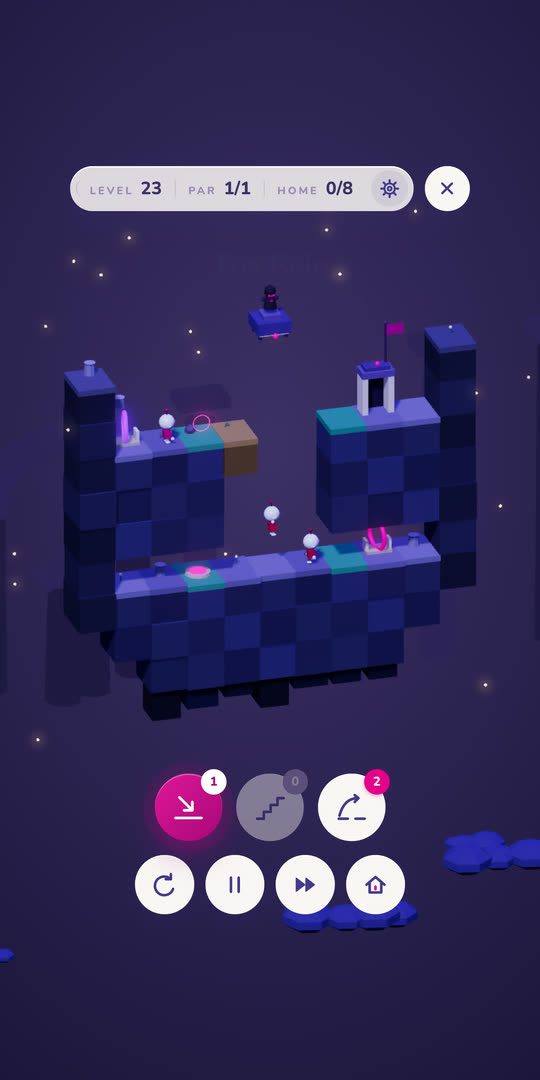
Deep blue night, portals and pressure plates. Everything the first three taught you, at once.
Nine skills
Every skill except one changes the world rather than the robot you gave it to, which is why the line behind it follows.
Straight down, leaving a shaft everything behind it drops into.
The same, at an angle — a slope down instead of a hole.
Horizontally through a wall, opening a corridor at the height it was walking.
A staircase forward and up. It stays there for everything that comes after.
Stands still and turns everyone else around. The cheapest way to buy yourself a plan.
One robot about-faces on the spot, without needing a wall or a blocker to do it.
Over a gap or up a ledge that is one too high to walk onto.
Survives the drop that would otherwise have been the end of it.
Up a wall instead of turning at it, which is the way out of a level with no floor to spare.
What is in the build
A garden, a mine, a coast and a ruin. Each one looks like itself and brings a new element with it.
Hand-made, named, and each with a goal of its own: how many have to come home, and in how few skills.
Dig, mine, bash, build, block, turn, jump, float and climb. Each level offers only some of them.
Getting enough of them home is a pass. Everybody home inside par is the full result, and it is there to be chased.
Pause any time, speed it up once you know the way, and call everyone back when it is clearly going wrong.
Every level is open once you have passed it, so a scrappy win is never the last word on it.
English and Dutch, switched on the title screen or in settings, right down to the level names.
No account, no sign-in, no network call. Your progress stays in the app storage on your own phone.
On a tablet
There is no separate tablet build. LOOP lays itself out for the screen it is on: the level gets the middle with space around it, the read-out collapses into one pill with the game name in it, and the controls sit together along the bottom.
It is the same twenty-three levels and the same nine skills — nothing is cut and nothing is added. What changes is how much of the board you take in before you decide where the line should go. Like Shift's, this side of it is still going through testing.
Shown on a ten-inch tablet. Seven and ten inch both work.

Questions
It is in its first test build, 0.1.0. The Android release is coming and there is no store link yet, because the build is not on Google Play.
Nothing. It is free permanently, with no advertising, no in-app purchases and no subscription.
Robots come out of a hatch and walk on their own. You tap a skill and then a robot, and whatever that does to the level changes the route for every robot behind it.
It was. Project Lem was the name of the folder it was built in. The game is called LOOP.
Twenty-three in this build, across four worlds, all hand-made. More come with later versions.
No. Nothing counts down. You can pause, speed the level up, restart it, or call every robot back and start the run again.
Yes. The same build lays itself out for the screen it is on, so a tablet gets more of the level in view. That layout is still being tested, so expect it to be rougher than the phone one.
Yes. There is no account and no network call. Your progress stays in the app storage on your own phone.